

At the very end of August 2016 right before our family vacation to Yellowstone I got last minute notice that Ainsley's one-on-one aide who we'd known for years wasn't going to be returning. She made it possible for Ainsley to access an education by attending school with her, be by her side and assist her with a variety of needs throughout the day, primarily physical and communication. The news was a shock because she had talked about how she intended to be with Ainsley through High School just a few months before. As usual the LWSD left us reeling in the final weeks of summer, apparently indifferent to the impact of such a change for a student with medical issues, special needs who is also non-verbal. After a series of e-mails the school hired someone and got things in place so I could bring her to school the first day to train the new aide as well as the back-up aide. In addition the new SLP sat in to get an overview of Ainsley's AAC system in ProloQuo2Go, aka "talker". Things seemed okay enough that I sent Ainsley to school as usual after that meeting.
Unfortunately the new primary aide didn't come to our house to ride the bus. They sent the back-up aide. He was a young guy who wasn't much interested in sharing details of what Ainsley was doing at school, leaving us quite uninformed (I'm quite sure the school made this change intentionally.). I'd hoped for some positive changes but after a couple weeks it seemed clear to me that Ainsley would be receiving instruction that was not dramatically different from prior years. Meaning not effective in teaching her how to communicate with AAC or how to read and write, the most basic of educational goals. Some things, like her Daily Write (Daily communication log and writing practice.) were actually more simplistic and were a step backward. Although the new primary aide said she was interested in learning to use Ainsley's talker so she could model what I found looking in the "Recents" history was that it was still being used very minimally. She would greet a person, comment a couple times during morning meeting, and maybe 1-2 other things. When you think how often a child speaks at school it would be massively more often than 5-10 times. And this included all the adult modeling on the device. If a speaking child spoke this little we would be worried about them. There was no way I could see them bridging the gap between what they were doing and what Ainsley needed to become an effective communicator and literate. We couldn't afford to "waste another year" hoping for an improved outcome when history showed a lack of understanding and support on the part of the school.
During the years Ainsley had a tracheostomy I attended school as her "nurse" when her nurse was unable. I spent many days in the classroom with her and saw exactly what they were doing throughout the day, the entire day in both special education and general education. Recess, PE, Music. Lunch. Assemblies. I could see that there was not nearly as much academic time as I'd expected, less than 2 hours a day. I saw that the kids were rushed (particularly problematic for a girl who is slow because of a cerebellum issue) and that there were behavior issues with some kids that made it difficult for the staff to do their jobs or for the children to remain focused (screaming in the class, kids standing on tables, that kind of thing). Honestly I'd considered homeschooling for years but was afraid. I'd even gone so far as to buy some homeschooling books in prior years like this and this. Honestly I should be glad that the aide left because it gave me the push to make a change. I checked into the law and requirements, talked to other moms who homeschool and attended a homeschool meeting by the Eastside Homeschool PTSA after which I had the courage to make this change. I decided that I was tired of spending my energy trying to get the school staff to support her needs without success and that we would be better off to take that energy and homeschool her.
Each state has different laws and requirements. Washington's requirements allow more freedom than some other states. I am a member of Washington Homeschoolers Organization. They have a great information page on the law, here. Where it became more difficult, in my mind, is that it is very difficult to assess Ainsley because she is pre-literate and non-verbal. In fact Special Educators in our district had incorrectly assessed Ainsley and other non-verbal students' knowledge of the alphabet, the most basic building block of education. Ainsley can be clever. They believed Ainsley knew her letters because she was good at reading cues was engaged and scored well with their method (essentially guessing). A less social girl who had known her letters for years (according to her mom) was drilled on letters because she was non-compliant (ie. simply refused to do what they asked, likely because it was far below her level). I ask, "If you can't tell whether a child knows the alphabet or not how can you be effective at teaching them?" I know my child better than anyone and I have more interest than anyone in her receiving a good education that prepares her for the best and most independent life she can live. For those reasons and many more homeschooling makes sense.
Something I observed was that while Ainsley was in the Gen Ed class the Special Ed teacher believed the Gen Ed teacher was in charge of the learning that happened during that time and the Gen Ed teacher believed Ainsley's education was the responsibility of the Special Education teacher. When a child is on an IEP I believe it can give the Gen Ed teacher a false sense that the teacher managing the IEP is really the teacher. I've seen teachers who really seemed to think they were doing enough just because Ainsley was in their classroom. Where does this leave a child like Ainsley? Although inclusion is a great goal careful attention has to be paid to how the child's Gen Ed time is used. Children like Ainsley have no time to waste. We wouldn't accept it for neuro-typical children to sit in class doing practically nothing and it's even more damaging to the education of a student who needs extra time to learn. The reality is even with an aide no one really made sure Ainsley did meaningful work when the Gen Ed curriculum was above her level (which it always was). At the end of the year notebooks would come home practically empty. I encourage anyone with a child on an IEP to make sure there are Gen Ed goals for each subject. Learn about the law and how to formulate a strong IEP here.
There was a lot of talk about the importance of Gen Ed time as spending time with her "peers". Ainsley is naturally social. She didn't need to work on social skills in the way some children with special needs do, but she enjoyed being with the other kids. What I saw at school is that the majority of kids were pretty nice to her but there were still some kids who would whisper about her to their friends or avoid sitting next to her. Thankfully Ainsley didn't notice but it could be heartbreaking to watch as her mother. At recess she would run around in her walker alone. Occasionally a child would come up and say hi before running off with their able bodied friends.When I helped her on the play equipment they just wanted her to move out of their way. As Ainsley got older I saw that the divide between the other kids got bigger. Although we call these kids "peers", they didn't really think of her as one of them. When Ainsley left the school not a single child's parents contacted us to say lets have a playdate, my child misses her or good luck we hope things go well for Ainsley. School was not a place that Ainsley made true friends.
Another major issue I had was the lack of a literacy program or a clear curriculum. In the beginning I naively I assumed that the IEP was not the entire curriculum but just areas of special focus after all you can't put every thing that is going to covered in detail into a syllabus. I thought it was a general outline not a complete list of everything they would do in school. The reality is that if it's not in the IEP you can't be sure it's going to happen. For example, I assumed that despite the goal of improving site word recognition they would still be working on teaching her to read using other methods. As it turned out that site word recognition goal was the entire reading "curriculum". Because the goals for the child need to be measurable I found that the educational activities were repetitive so that the staff was able to take data to measure progress. Many of the day-to-day activities (they did do some fun stuff) were boring. When Ainsley started having some behavior issues at the end of the year. I reminded staff that non-verbal communication is communication. Refusal to do the work and other behavior issues are a non-verbal child's way of telling you loud and clear in the only way they can, "There is a problem!" Imagine what it would feel like to be unable to communicate with words in a way that could help people understand your thoughts and feelings when in a situation that you didn't like, imagine the sense of powerlessness! How might you act or get your message across? After our conversation they made changes to her work, giving her new things to do, and the behavior improved immediately, because she was engaged. How many kids with behavior issues in school are just frustrated by their circumstances because of the environment and methods of instruction?
My first goal for Ainsley for this year was to restore a child's natural love of learning and doing. School has a way of destroying that for many students. Through homeschooling I am able to vary my methods of instruction and provide a variety of activities to teach the same things to help keep things fresh and engaging. Ainsley's cerebellum difference makes her require more repetition for her to learn which can easily become boring if you aren't creative. She doesn't like to do the same things over and over any more than anyone else does.
Take for example learning the letters. At school they had her choose from a field of 3 or 5, ID'ing the letters by pointing to the spoken letter. They believed improvement in their data indicated she had nearly learned them. That was all they did for letter recognition. My assessments showed that when you increased the field to 26 she could no longer identify many of the letters. She didn't know them, however, she knew enough of them that she got really good at guessing through a process of elimination.
At home we alternate activities to keep things interesting. Like in the case of learning letters/letter sounds and how to read we might: review the letters with phonics sounds together using flashcards or by tracing the letters in an ABC book while reading, watching a letter video in the car, playing an app like Endless Alphabet or ABC Ninja, reading a variety of alphabet books together, play a computer game, read an e-book independently, tracing sensory letter cards while reviewing the sounds, read acrostic poetry book, Mystery Box match items to the beginning letter, do a puzzle, use worksheets, cookie spelling or PhonicFaces train spelling. Does this work? After nearly a year of homeschooling she can identify all 26 letters from a field of 26 nearly all the time (some mixing up of b & d, g, p & q on occasion as you'd expect because they look so much alike and are easily mixed up). She can identify the letter that corresponds to a sound in random order, from a field of 26. She is starting to take interest in spelling words independently using her talker, typing the letters of words she sees into it to see what they say. She can write all 26 letter of the alphabet with just verbal prompts.
Ainsley's progress in school has been very slow. My assessment shows she's made more growth in 1 year than in all her previous years in regular school. I am confident that we can do at least as well as the school. This year we were also able to add in SafeGait Therapy at Children's and Speech Therapy. We're trialing Gemiini for speech. She's picked up some new speech sounds (from our phonics work, not related to Gemiini, yet). She's been riding her therapy horse to increase core strength and using the stander a lot. She's had a bunch of doctor appointments resulting in surgery planned for September 2017, but more about that another time. She hasn't been sick all year (a clear benefit of no school germs for a child with an iffy airway). She's learning life skills like how to dress herself with only a little help. She's helped with laundry, cooking, grocery shopping and yard work.We learned about the mail system when she made and sent Valentines to the Grandparents. She's made a little progress with math (not our biggest area of focus, it wasn't on her IEP either). For Science we learned about the seasons with special focus on items in nature depending on the season. After many years, she's finally truly mastered colors! A lot of great stuff!
We've done school in bed, on the couch, on the patio, in the car, at the doctor and sometimes even in our "classroom". What I've learned is that Homeschooling should be more flexible and fun than "School" school. It can be a great way to spend quality time together. I don't want to make it out like it's always fun, but the good outweighs the bad and it looks like we're sticking with it. At least until Ainsley has learned to read, write and communicate effectively with AAC. At that point she may be better equipped to attend public school and we will reevaluate and consider what is best for her just like we always do.
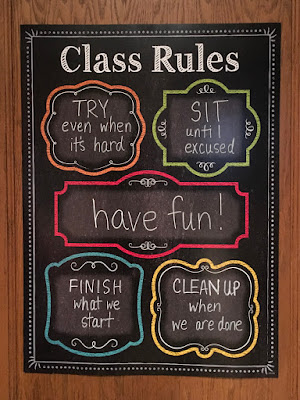
What's even better than the "academic progress" (Ainsley was on a "Life Skills" IEP at school.) is that she is proud of herself and very happy. Even happier than our happy girl always has been. We've had some challenges. My mom(adoptive) fell in September and had a head injury leaving us in crisis mode for awhile as we tried to sort things out. Adrian's school carpooling cut an hour and a half or more into our school time on M, W, & F. I'd agreed to be on the PTSA board and though there were many times I was tempted to quit, I managed to hang in and fulfill my duties. Evie became active in drama so most of the year I'd have to leave shortly after getting home to go pick her up, all 5 days a week, then come home and start dinner. School often dragged into the night, up until bedtime. The personal time I naively thought I might get in the evenings wasn't a reality. Next year Adrian will be taking the bus to the High School with Evie and that will improve things quite a lot. I'm looking forward to it and they are excited to be back together again. My plan is to continue to homeschool over the summer on a reduced schedule. It might look like sitting out on the patio lounger reading books and talking AAC with a little letter and writing work a few times a week to keep her from regressing over summer. Hopefully the weather will be dry and we can get her physically active outside. I have some school rules I hung up in the "classroom". The one at the center is the most important and hardest for me personally to achieve and that is "Have fun." Especially important for summer school!






During the years Ainsley had a tracheostomy I attended school as her "nurse" when her nurse was unable. I spent many days in the classroom with her and saw exactly what they were doing throughout the day, the entire day in both special education and general education. Recess, PE, Music. Lunch. Assemblies. I could see that there was not nearly as much academic time as I'd expected, less than 2 hours a day. I saw that the kids were rushed (particularly problematic for a girl who is slow because of a cerebellum issue) and that there were behavior issues with some kids that made it difficult for the staff to do their jobs or for the children to remain focused (screaming in the class, kids standing on tables, that kind of thing). Honestly I'd considered homeschooling for years but was afraid. I'd even gone so far as to buy some homeschooling books in prior years like this and this. Honestly I should be glad that the aide left because it gave me the push to make a change. I checked into the law and requirements, talked to other moms who homeschool and attended a homeschool meeting by the Eastside Homeschool PTSA after which I had the courage to make this change. I decided that I was tired of spending my energy trying to get the school staff to support her needs without success and that we would be better off to take that energy and homeschool her.
Each state has different laws and requirements. Washington's requirements allow more freedom than some other states. I am a member of Washington Homeschoolers Organization. They have a great information page on the law, here. Where it became more difficult, in my mind, is that it is very difficult to assess Ainsley because she is pre-literate and non-verbal. In fact Special Educators in our district had incorrectly assessed Ainsley and other non-verbal students' knowledge of the alphabet, the most basic building block of education. Ainsley can be clever. They believed Ainsley knew her letters because she was good at reading cues was engaged and scored well with their method (essentially guessing). A less social girl who had known her letters for years (according to her mom) was drilled on letters because she was non-compliant (ie. simply refused to do what they asked, likely because it was far below her level). I ask, "If you can't tell whether a child knows the alphabet or not how can you be effective at teaching them?" I know my child better than anyone and I have more interest than anyone in her receiving a good education that prepares her for the best and most independent life she can live. For those reasons and many more homeschooling makes sense.
Something I observed was that while Ainsley was in the Gen Ed class the Special Ed teacher believed the Gen Ed teacher was in charge of the learning that happened during that time and the Gen Ed teacher believed Ainsley's education was the responsibility of the Special Education teacher. When a child is on an IEP I believe it can give the Gen Ed teacher a false sense that the teacher managing the IEP is really the teacher. I've seen teachers who really seemed to think they were doing enough just because Ainsley was in their classroom. Where does this leave a child like Ainsley? Although inclusion is a great goal careful attention has to be paid to how the child's Gen Ed time is used. Children like Ainsley have no time to waste. We wouldn't accept it for neuro-typical children to sit in class doing practically nothing and it's even more damaging to the education of a student who needs extra time to learn. The reality is even with an aide no one really made sure Ainsley did meaningful work when the Gen Ed curriculum was above her level (which it always was). At the end of the year notebooks would come home practically empty. I encourage anyone with a child on an IEP to make sure there are Gen Ed goals for each subject. Learn about the law and how to formulate a strong IEP here.
There was a lot of talk about the importance of Gen Ed time as spending time with her "peers". Ainsley is naturally social. She didn't need to work on social skills in the way some children with special needs do, but she enjoyed being with the other kids. What I saw at school is that the majority of kids were pretty nice to her but there were still some kids who would whisper about her to their friends or avoid sitting next to her. Thankfully Ainsley didn't notice but it could be heartbreaking to watch as her mother. At recess she would run around in her walker alone. Occasionally a child would come up and say hi before running off with their able bodied friends.When I helped her on the play equipment they just wanted her to move out of their way. As Ainsley got older I saw that the divide between the other kids got bigger. Although we call these kids "peers", they didn't really think of her as one of them. When Ainsley left the school not a single child's parents contacted us to say lets have a playdate, my child misses her or good luck we hope things go well for Ainsley. School was not a place that Ainsley made true friends.
Another major issue I had was the lack of a literacy program or a clear curriculum. In the beginning I naively I assumed that the IEP was not the entire curriculum but just areas of special focus after all you can't put every thing that is going to covered in detail into a syllabus. I thought it was a general outline not a complete list of everything they would do in school. The reality is that if it's not in the IEP you can't be sure it's going to happen. For example, I assumed that despite the goal of improving site word recognition they would still be working on teaching her to read using other methods. As it turned out that site word recognition goal was the entire reading "curriculum". Because the goals for the child need to be measurable I found that the educational activities were repetitive so that the staff was able to take data to measure progress. Many of the day-to-day activities (they did do some fun stuff) were boring. When Ainsley started having some behavior issues at the end of the year. I reminded staff that non-verbal communication is communication. Refusal to do the work and other behavior issues are a non-verbal child's way of telling you loud and clear in the only way they can, "There is a problem!" Imagine what it would feel like to be unable to communicate with words in a way that could help people understand your thoughts and feelings when in a situation that you didn't like, imagine the sense of powerlessness! How might you act or get your message across? After our conversation they made changes to her work, giving her new things to do, and the behavior improved immediately, because she was engaged. How many kids with behavior issues in school are just frustrated by their circumstances because of the environment and methods of instruction?
My first goal for Ainsley for this year was to restore a child's natural love of learning and doing. School has a way of destroying that for many students. Through homeschooling I am able to vary my methods of instruction and provide a variety of activities to teach the same things to help keep things fresh and engaging. Ainsley's cerebellum difference makes her require more repetition for her to learn which can easily become boring if you aren't creative. She doesn't like to do the same things over and over any more than anyone else does.
Take for example learning the letters. At school they had her choose from a field of 3 or 5, ID'ing the letters by pointing to the spoken letter. They believed improvement in their data indicated she had nearly learned them. That was all they did for letter recognition. My assessments showed that when you increased the field to 26 she could no longer identify many of the letters. She didn't know them, however, she knew enough of them that she got really good at guessing through a process of elimination.
At home we alternate activities to keep things interesting. Like in the case of learning letters/letter sounds and how to read we might: review the letters with phonics sounds together using flashcards or by tracing the letters in an ABC book while reading, watching a letter video in the car, playing an app like Endless Alphabet or ABC Ninja, reading a variety of alphabet books together, play a computer game, read an e-book independently, tracing sensory letter cards while reviewing the sounds, read acrostic poetry book, Mystery Box match items to the beginning letter, do a puzzle, use worksheets, cookie spelling or PhonicFaces train spelling. Does this work? After nearly a year of homeschooling she can identify all 26 letters from a field of 26 nearly all the time (some mixing up of b & d, g, p & q on occasion as you'd expect because they look so much alike and are easily mixed up). She can identify the letter that corresponds to a sound in random order, from a field of 26. She is starting to take interest in spelling words independently using her talker, typing the letters of words she sees into it to see what they say. She can write all 26 letter of the alphabet with just verbal prompts.
Ainsley's progress in school has been very slow. My assessment shows she's made more growth in 1 year than in all her previous years in regular school. I am confident that we can do at least as well as the school. This year we were also able to add in SafeGait Therapy at Children's and Speech Therapy. We're trialing Gemiini for speech. She's picked up some new speech sounds (from our phonics work, not related to Gemiini, yet). She's been riding her therapy horse to increase core strength and using the stander a lot. She's had a bunch of doctor appointments resulting in surgery planned for September 2017, but more about that another time. She hasn't been sick all year (a clear benefit of no school germs for a child with an iffy airway). She's learning life skills like how to dress herself with only a little help. She's helped with laundry, cooking, grocery shopping and yard work.We learned about the mail system when she made and sent Valentines to the Grandparents. She's made a little progress with math (not our biggest area of focus, it wasn't on her IEP either). For Science we learned about the seasons with special focus on items in nature depending on the season. After many years, she's finally truly mastered colors! A lot of great stuff!
We've done school in bed, on the couch, on the patio, in the car, at the doctor and sometimes even in our "classroom". What I've learned is that Homeschooling should be more flexible and fun than "School" school. It can be a great way to spend quality time together. I don't want to make it out like it's always fun, but the good outweighs the bad and it looks like we're sticking with it. At least until Ainsley has learned to read, write and communicate effectively with AAC. At that point she may be better equipped to attend public school and we will reevaluate and consider what is best for her just like we always do.
What's even better than the "academic progress" (Ainsley was on a "Life Skills" IEP at school.) is that she is proud of herself and very happy. Even happier than our happy girl always has been. We've had some challenges. My mom(adoptive) fell in September and had a head injury leaving us in crisis mode for awhile as we tried to sort things out. Adrian's school carpooling cut an hour and a half or more into our school time on M, W, & F. I'd agreed to be on the PTSA board and though there were many times I was tempted to quit, I managed to hang in and fulfill my duties. Evie became active in drama so most of the year I'd have to leave shortly after getting home to go pick her up, all 5 days a week, then come home and start dinner. School often dragged into the night, up until bedtime. The personal time I naively thought I might get in the evenings wasn't a reality. Next year Adrian will be taking the bus to the High School with Evie and that will improve things quite a lot. I'm looking forward to it and they are excited to be back together again. My plan is to continue to homeschool over the summer on a reduced schedule. It might look like sitting out on the patio lounger reading books and talking AAC with a little letter and writing work a few times a week to keep her from regressing over summer. Hopefully the weather will be dry and we can get her physically active outside. I have some school rules I hung up in the "classroom". The one at the center is the most important and hardest for me personally to achieve and that is "Have fun." Especially important for summer school!

And now what you really want, the PHOTOS!
LIFE SKILLS

She's been loving the days she gets to sleep in and start the day with breakfast in bed and some reading. A slower start suits her constitution. She's not as exhausted from the physical demands of school.

She learned to dress herself now that our mornings aren't so rushed. Sometimes the clothes went on backward, but that's ok, it's part of the learning. If she gets it wrong she gets to feel the natural consequences if she doesn't want to fix it. We're also working on learning to shampoo her own hair, wash her body, and brush her hair and teeth.

On days that I had to pay bills she played "paying bills" too.

We worked on Life Skills with shopping excursions. Sometimes I let her pay so she learns about money, even if I could feel the eyerolls of the customers next in line. We're still working on not running down the isles away from mom because it's funny.

She learned measuring and pouring, while working on baking skills.

We got a little messy, but that's why we use a LifeProof waterproof case for her talker.

We made Pumpkin Cranberrry bread. I used to make it every year but it had been awhile. So delicious! Sometimes she worked on helping with food prep or dinner.

Cutting skills making Valentine's for Grandparents and learning about the postal system and visiting the post office to purchase stamps.

We joined a local homeschool group looking for social opportunities. We really like to meet other kids with special needs who are homeschooling. At this event we made origami hummingbirds. Ainsley was able to participate with my assistance and help with communication. The kids were very kind (except for the boy who moved because he didn't want to sit by her). The group has a lot of meetups you can pick and choose from but most are more like field trips and aren't easy for someone with physical disabilities to keep up or the timing conflicted with carpool. My hope for next year is that our days are more open so we can go on more outings like this. And perhaps make some real friends.
PHYSICAL/GROSS MOTOR

We started a policy of Disney Infinity requiring the stander to get in more standing practice to make up for the lack of recess and PE. She's gotten quite good at DI. It's been highly motivating and effective! The game is also good for eye hand coordination and fine motor skills, cause and effect, motor planning (on screen), and especially negotiation tactics.

Core strengthening on her "therapy horse" from iGallop.

We also did an intensive bout of SafeGait therapy to work on improving forearm crutch form for safety as well as to attempt hands free walking (we found she will need surgery first.) She's getting stronger. We are trying to be consistent with our home exercise and stretching routine.
SPEECH/COMMUNICATION

Homeschooling gave us the freedom to squeeze private Speech Therapy (specializing in AAC) into our busy schedule. We're still attending monthly AAC meetings with our Smooth Talkers group of AAC using kids. Of course we use AAC around the house in a variety of ways in so much of what we do. More posts about that coming in the future.

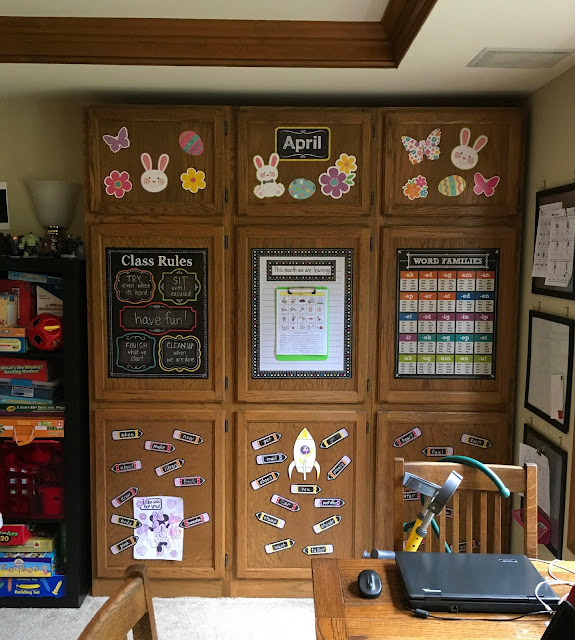
In January we started selecting 20 core AAC words each month to focus on. The words fit our learning theme and we display these on our school wall. We are creating a word wall too. Once she's learned to find the word in her talker we put it on a pencil on our wall. She loves it when she is awarded a pencil to place on the wall!

This was a great way to learn the verb "go" in AAC while also working on colors: a game making different colored cars "go".

One by one Ainsley would tell me which color car got to "go". We would guess which color would win the race. She loved having the power!

The Three Little Pigs with AAC. Trying to learn to blow.

Because of her progress with letters she was able to get a better vision test, using AAC.

Best of all our hard work on AAC has paid off with lots of sentences.
Next we will be correcting her grammar.
FINE MOTOR

We got sensory beads (sold in smaller less expensive bags at the store) in a tray with a lid. I would change out the items she plays with in it every month. It's also good for pouring skills. Here we were also working on counting.

These bunny erasers (Target $1 section) were so fun for Easter. We worked on "hop", "find" and "munch". The little beads end up all over the floor, but picking them up is good fine motor pincer exercise.

Light Bright for Fine Motor (and letter A but we discovered this is not a good letter activity, it takes too much time to effectively learn letters).
MATH

Counting with Counting Gardens.

Math and AAC with Hi-Ho Cherry O!

Counting by tens to beginning to understand the concept of 20's, 30's, 40's etc.

Spatial reasoning with pattern building blocks.
SCIENCE

We learn about the seasons and how they are influenced by the sun. We read a bunch of books (zoom in to see) about apples. We visited the grocery store to buy 3 different colors of apples to compare taste. We visited the park to look for acorns, collect leaves and other items even finding a wild apple tree with an apple we were able to bring home and taste. We made dried apple rings.

We got some "sink PT" (aka standing) while learning about buoyancy with this STEM kit.

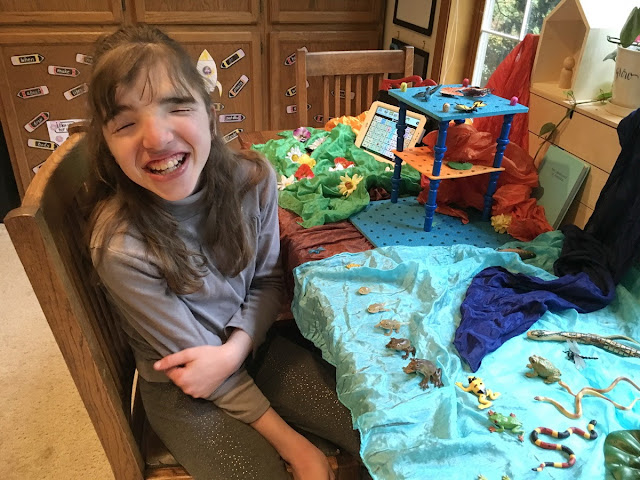
Nature Habitat with play silks, pegs and frog life cycle.

Sometimes we school in the car. We spent a LOT of time in the car this year.

After reading the book Mossy we made this picture. I helped with coloring the edges while we waited at the doctor. Later she cut out and added the "garden"on Mossy's back.

We made a garden in May and she learned to water the plants (Filling the water can is good hand strengthening too.)

Planting seeds.

Our greens. We also planted tomatoes, pumpkins, zucchini, cucumbers and herbs.
COLORS/MATCHING/SORTING

Color sorting and differentiation with matching socks.

We practiced saying the colors and words for all the items in her Rainbow Crayon Sorting Tubes.
READING

We've made many trips to the library, a homeschooler's best resource! This day they had books wrapped like presents you could check out to celebrate their 75th Anniversary. Fun! Her "present" was Rapunzel. She likes to use the computer while I find books to go along with what we are learning.

We read a lot of books and tried to tie into our stories with fun elements like Magic Bean candies while reading a classic like Jack and the Beanstalk.


Yum! (They are actually quite good.)
LETTER ID/PHONICS/SPELLING/VOCABULARY
There were so many other ways we worked on pre-reading and writing skills there is just no way to show them all! Here are just a few.....

Computer skills (using old games on an old laptop).

We read the Autumn, Winter and Spring Acrostic books. (And Summer soon.)

She types in the first letter of each line into her talker to reveal the secret word after I finish the poem.

Then we would find the word in her talker (using the symbol). I LOVE these books!

She often used these word building boards which are kind of like a puzzle.

She got quite good at matching opposites.

More computer skills with letters and phonics.

We worked on building words using phonics with the PhonicFaces Train. She's picked up a few new sounds she can imitate, from running through the PhonicFaces flashcards.

Fill in the missing letter magnet in each word.

Spelling is more fun with cookies....
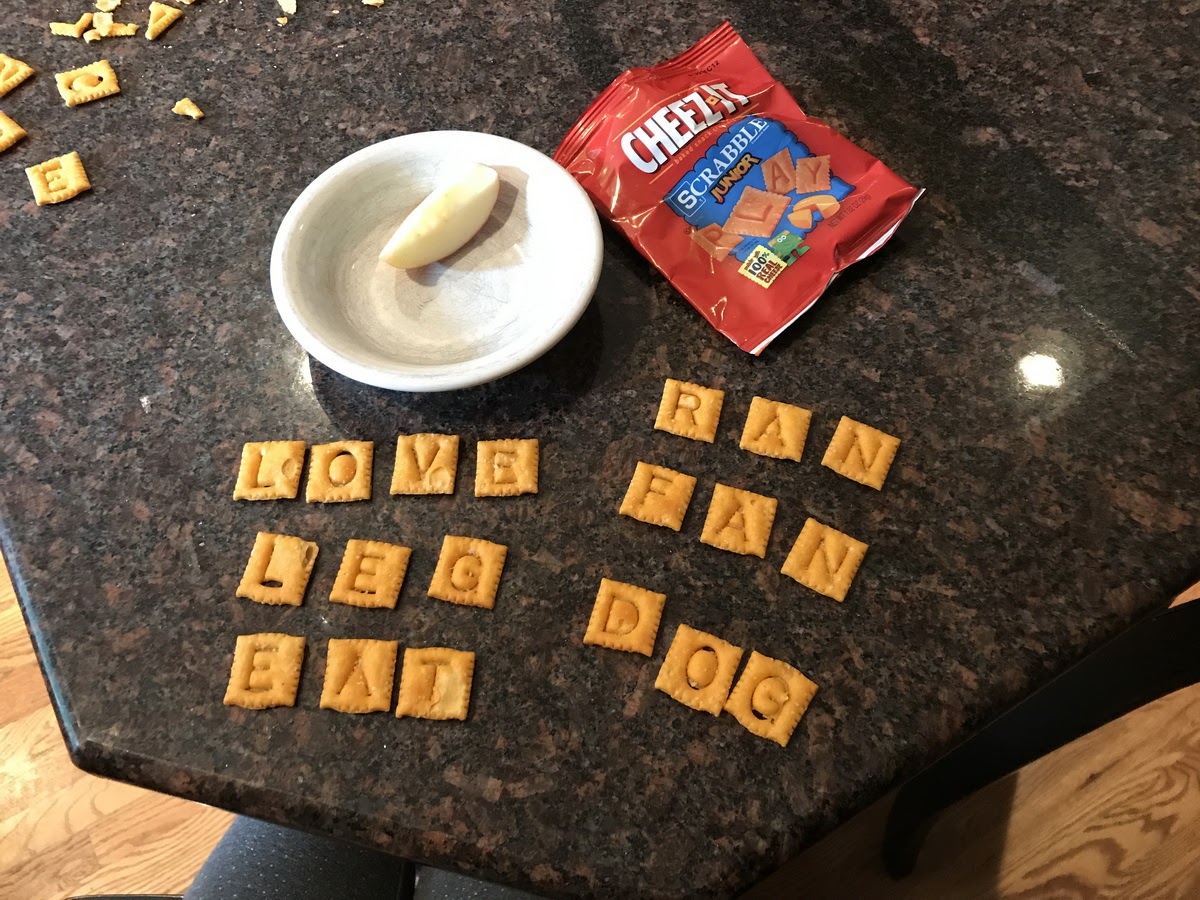
...or crackers. I would make the word. She'd type it into her talker to "say" the word before eating it.

Learning phonics sounds with the Alphabet Mystery Box. As you pull out each item from the box you place it on the corresponding letter. She can do a lot of these independently now.

Making Silly Alphabet Soup in her play kitchen. We find a food for each letter of the alphabet. Then we'd say it with her talker.

Of course we pretended to eat the silly soup when we were done.
WRITING


Sensory writing in a salt tray. Yes it's fun.
(It's messy. Don't do it. Or if you do, don't blame me when it's time to clean up the salt or when you find your child licking it off their fingers like you made her a special yummy treat.)
(It's messy. Don't do it. Or if you do, don't blame me when it's time to clean up the salt or when you find your child licking it off their fingers like you made her a special yummy treat.)

Ainsley's drawing skills have improved a lot this year! The writing was hand over hand because the focus was learning letters and how words and sentences are formed not penmanship.

We used a light up board to trace and draw with Draw Write Now (you make a copy of the page first).

Given the letters verbally, one at a time, Ainsley can write them independently with no model!

She's learning to copy. This was independent. I think she's now ready for copywork.

This was her idea, typing in the word from the tag. I guess she wanted to know what it said.
So smart!
So smart!
I hope you've enjoyed seeing pictures of just some of the homeschooling activities from Ainsley's first homeschool year. Homeschooling a non-verbal child has it's challenges but it can be fun too! Historically literacy levels for non-verbal students are low, but with some creativity (and homeschooling) I believe Ainsley will learn to read and write! Thanks for checking in.


.JPG)


