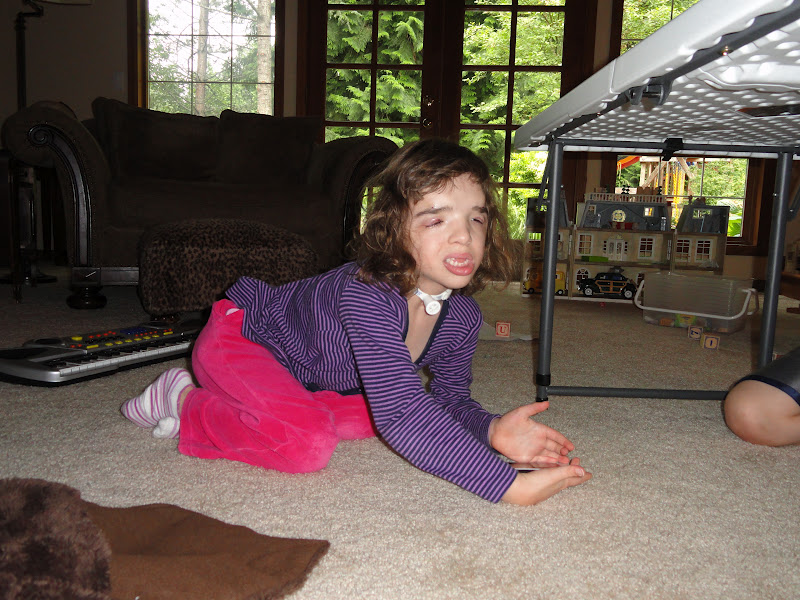
Last week we had two important appointments with the craniofacial clinic and the occuloplastics surgeon. I've been wanting to blog but we had another round of illness hit our family (with all 3 kids missing school at various times), and I have been taking photos for Evie's school as well as adjusting to a new nurse (to replace the one who was fired in February for hitting her Ainsley in the classroom in front of a teacher and students) as well as dealing with important issues that have come up with the school . Unfortunately (or fortunately) I am not compelled to stay up late blogging like I used to. I function better when I get decent sleep.
Ainsley has had a bump on top back part of her skull, almost like a goose egg from a fall, except it isn't. She also has a depression at her left temple. Both areas have gotten worse as she's gotten older, especially in the past few months. This wasn't the first time I'd mentioned them to the surgeon. I've been concerned and was really half expecting that she would need surgery. Thankfully she doesn't. I found out that any minor bumps are unlikely to cause pressure or trauma to the brain (the brain is squishable like jello, it takes more than a small irregularity to cause a problem), and are likely irregular bone growth due to the fact that Ainsley's skull was cut apart and pieced back together like a jigsaw puzzle when she was a baby. The bone is all in different places than it was and likely the irregularity is caused by that. Really it's amazing she looks as good as she does when you see the imaging.
They told us it is important to have her eyes dilated yearly to check for papilledema, or pressure on the eyes from the brain being under pressure. Good to know. Thankfully the ophthalmologist did that in January and her pressures were good. While I was there I discussed Ainsley's eye appearance and he could see my concern about the pinching in the corner of her left eye. We've been seeing more discharge from that eye for awhile, and the usual fix, tweezing out the inwardly rotated eyelash, didn't help. I mentioned it again at the craniofacial appointment and it was agreed something should be done so we saw the occuloplastic surgeon. He agreed to do surgery to the left eye.
Then Tuesday night I found a large quantity of discharge that seemed to out come from behind her eyeball. I've never seen anything like it, ever. The next day it appeared she was far more able to open her eye. I have no idea for sure what was going on but suspect there must have been a foreign object in there for quite some time. It is hard to see because the opening of her eyes was made overly small during surgery (her palprebal fissure was shortened). None of the doctors fully looked inside her eye despite my report of unusual discharge, I presume because of how difficult it is to pry them open. Now I am concerned that the surgery we have planned may "over-do" things and I feel like it would be smart to go back to the surgeon to give him the opportunity to see her again before planning the surgery. I tried to write an e-mail to both surgeons and ended up spending several hours watching videos about the structure of the skull and looking at her imaging. I had no idea the skull was so complex. It left me feeling overwhelmed with even more questions. I learned that the sphenoid bone connects to the nasal cavity, and that makes me wonder if perhaps that may contribute to Ainsley's breathing difficulties since there was an abnormality of her sphenoid bone. I decided to wait, and finish this blog post and the e-mail over the weekend. Sometimes you just have to preserve your state of mind.
Ainsley was said to be born with absence of the greater sphenoid wing bone (in her skull, but not the entire bone, just part of it) which was found when they took the MRI's to prepare for the cranial surgery. Absense of the greater wing of the sphenoid is extremely rare. However, by the time she was ready to have her second craniofacial surgery the bone had started to grow. In hindsight I believe that the sagittal craniosynostosis caused the sphenoid fontanelle to be larger than normal, just like it did the anterior fontanelle. As you can see in the imaging below, a few months following her first surgery to open the sagittal suture all the fontanelles look quite a lot smaller. During the second craniofacial surgery bone was placed behind her eyes to keep her eyes from touching the dura around her brain. After this surgery her eyes appeared slanted and were very closed. This is likely due to the fact that bone was moved and her skin had been covering a skull that was differently shaped. Even though Ainsley' eyelid tissue was insufficient prior to surgery she was able to compensate and use her brow to fully open her eyes. After the surgery she was no longer able to.
Sphenoid fontanelles and absence of the greater sphenoid wing.
The sphenoid fontanelle after sphenoid growth. (Not surgically altered.)
My hope has always been that the surgeons could figure out a way to fix the results of that second craniofacial surgery. They have tried. She had brow prosthetics placed in Jan. 2010, a tarsal switch and canthopexy surgery in Dec. 2010, and a frontalis sling in Jun. 2012. The surgeries improved things some. Ainsley can function better, but her appearance is still not normal. I believe that if her eyes appeared now as they did when she was born, people would have a different impression of Ainsley and treat her differently.
In January when I was at Jack's funeral I was talking with another mom. Her son has had 30 craniofacial surgeries and was trached as well. When I told her my child had sagittal craniosynostosis and showed her a picture she asked if she'd had surgery yet. It was a heartbreaking realization, that even an experienced craniofacial mom who knows what it is to have a child who looks different (her son was born with a hole in his face) cannot see that her work is finished, and in fact thinks it hasn't even started. It isn't a matter of her being insensitive as the surgeon suggested when I told him. It is the reality of the results from her surgeries. They do say that she has some extra skin on her eyelids that can be removed, but not until she is 14. How do I know that will fix things? I don't. How do I know that the surgery they propose doing now, won't look funny after the skin is removed 7-10 years from now? I don't.
I think that one of the hardest things about being a parent of a medically complex special needs child is making decisions for which there are no easy answers. You have to educate yourself and advocate for your child to get them the best care possible. I know many parents who have pushed doctors to perform surgery past what they were comfortable with (sometimes switching surgeons), and the outcome was exactly what their child needed. But there is always the fear of making the wrong decision since there are no guarantees in surgery or medicine. The eyes are delicate and very important. They say the eyes are the windows to the soul. I just want to make it easier for people to see Ainsley's beauty like I do, and for her to be able to live the best life possible. That is what I always try to do. I will let you know if the surgery is going to happen or not as soon as we know.
I think the thing people notice first about Ainsley (besides that she's cute and sweet) is that her eyes look different. The trach, the g-tube, the scars, being non-verbal, non-ambulatory (walking) all that gets less attention. People always wonder about the eyes. I can tell. And it's the first things kids ask about and that is a give-away. I have learned to try not to let it bother me and to keep my explanations short and simple (if I give any at all) because it otherwise it takes a lot of energy and makes me feel bad. But I will explain it here in depth because it really isn't as simple as "she was born that way."
Tomorrow marks one year since Ainsley had the third surgery to "fix" her eyes. It's been a long road. You can find more detail by reading past posts labeled ptosis. Here is the story in the smallest nutshell it will fit.
Ainsley was born with mild to moderate ptosis (droopy eyelids).
When she was born she didn't open her eyes right away. For weeks it seemed, but now that I look back at pictures I can see she also spent a LOT of time sleeping. Which makes sense since babies do that, especially when they have a breathing tube down their throat and they are stuck unable to move, in a hospital crib.
The top ophthalmologist at Children's checked her out and he said "Her eyes are fine, Mom"..."the disc to cup ratio is a bit high and blah-de-blah...." Basically, don't worry. What I didn't know is that this is the guy who sees the worst eye problems. So from his perspective if you can see things are good.
I was still worried. I knew her eyes should be more open than they were. (Picture at 1 month old.)
After the the tracheotomy was done she did open them more and I was relieved and yet they still weren't as open as "normal".
But when she wanted to she used her brow to lift her eyelids higher and then her eyes looked fully open. The eye surgeon told us that a Frontalis Sling surgery would make it so her eyes would be fully open all the time and she would appear "normal". Sadly I looked forward to that, not knowing that I should treasure the 9 months I got to see her beautiful eyes this easily because things would get worse, much worse, not better...and in fact would never be this good ever again in her whole life.
Here are pictures so you can see for yourself, and see the progression as we get to where we are now 3 surgeries later.
Here she is at 3 months age before the 1st cranial surgery to the rear part of her skull.
4 months old after that surgery (hence the shaved head).
7 months old.
9 months old.
This photo of me watching her, taken the day before the fateful second cranial surgery, is very poignant. I actually believed she would come out of the surgery with her forehead and her eyes looking better. None of us knew that the reconstruction of her forehead, which was done to give her brain room to grow and fix the shape that was caused by the craniosysnostosis, would cause BIG problems.
She went from this.....
......to this overnight. She was 9 months old when this surgery was done.
Here she is the night before the surgery.
To be clear, her eyes weren't perfect before the surgery. Here in this picture she is relaxed and not using her brow at all to lift her lids. This is the amount of ptosis she was born with.
When she used the brow she could get more lift as you can see the difference from comparing this photo to the last. Now we would be thrilled if she had this kind of function.
To be fair the surgeon (who is top in his field and amazing) Ainsley was a really complex case.
This is what he did.
See how the brow bone and front of her skull was cut apart and re-assembled into a new shape with lots of little pieces? He also replaced some bone that was behind her eyes. I'm not sure if he had to remove her eyeballs to do that. I probably don't want to know. But without it her eyes would be resting against the dura of her brain...which is not good. It was likely the repositioning of the bone that caused the eye appearance to change. And it's possible that the swelling damaged the muscles (though that depends on if you believe surgeon A or B).
Anyway, back to the eyes. Since pictures can lie, I thought I'd also post some video so you can see how her eyes worked before the surgery. Plus they are cute and fun to see this many years later.
Here she is sitting for the first time at 8 months age.
Here she is teething, age 7 months.
At our post surgery appointments we were told things could improve and to be patient.
A months later she's cute as a bug. But the eyes are still not opening as much, and appear downward slanted.
6 months later at age 15months, when she was smiling her eyes looked pretty much closed.
Using the brow they were better, but let's face it, not great. At this time she'd had hip surgery and is in a spica cast (the first one). Unfortunately this issue with the eyes is only 1 of many health issues.
I research options and talk to surgeons. And try to be patient for her eyes to improve, for her airway to get better and many other things.
Over two years pass and her eyes do not improve. There is a surgery that may help her but the ophalmological? eye surgeon thinks there isn't enough brow bone.
So in January 2010 at age 3 she has eyebrow prosthetics placed by the craniofacial surgeon. Not the hair. The bone. Fake bone, custom made to fit her skull implanted by cutting her scalp open and peeling back her forehead to surgically build up her brow bone. It did lift her lids a millimeter or two and created a solid foundation for future surgeries.
We consulted back and forth between 3 different eye surgeons and got differing opinions. We asked for the craniofacial surgeon to weigh in, since it was the surgery he did that caused the problem. I hoped he might have insight into what caused and how to fix the problem. It the end we made a decision to do the Tarsal Switch Surgery where they removed part of the upper tarsus and placed it in her lower lid to help correct the slanting that was caused by the craniosynostosis repair. The idea is that it would also raise the upper lid position as well as prop up the lower lid and thus "kill two birds with one stone".
The surgeon came out of the OR and said he "also" removed some of the length of her eye, essentially shortening the opening of her eye. He removed 4-5 mm of length which in my opinion was too much and it created a pinched appearance. Since I wasn't expecting this I was quite upset about the loss of so many of her beautiful eyelashes. She was quite swollen and it was hard to see her so miserable. Again the doctor said "be patient" and so we waited hoping that it would get better.
One month post tarsal switch.
Two months post tarsal switch.
More than a year post tarsal switch. About that time things got better. We did find she could lift more than before but the starting lid position was clearly a problem. Her lids were so low that it took a lot of effort to raise them. So we decided to move forward with the Frontalis Sling Surgery.
This procedure was comparatively minor. They opened up the incisions from the past surgery and sewed donor tendon to the levator and then sewed that to the forehead muscles. This would allow her to use her brow to lift the eyelids and would also also raise the lid starting position. We watched and hoped for a miracle. What we got is slow gradual progress which you can see here.
This is really the end of the road for surgery. She does have a little extra eyelid skin which they may remove, but not until she is a teenager. So at this point we are done. At rest her eyelids are pretty closed. But close to a year post-surgery we started to find that she was using the sling more and more to lift her eyelids.
This photo was taken last weekend.
And I also have a recent video so you can see in action how she uses the sling to lift her lids.
There was a time that I felt the droopy lids were having a negative impact on her development. Even though they still look different we've come a long way. I hope she will some day use the slings to open the lids the way she did when she was a baby. But since her lids were surgically altered and her resting eyelid position is lower I know they will never look the same as they did before the surgery that caused the problem. She has started using the sling more and more and I feel like she must be able to see better because of it. Of course she has always been beautiful to us, always will be, and we love her more than words can describe.
That is the story of Ainsley's eyes and why they look the way they look.
Ainsley's had ptosis surgery on Friday 6/15. If somehow you missed it, you can find the posts here, here, here, here and here. Here are some more photos so you can see how she's been healing since my last post.
We had our 1 week post-op appointment on Thursday. We expected that her eyes would no longer close completely when she sleeps but so far they have (they are open about 1mm, maybe 2). That may be a sign that we didn't get as much lift as the surgeon planned, or it may just be due to the residual swelling. Dr. S says he's encouraged that there is some change in her sleeping eyelid position and hopes that means we got some lift but that we have to be patient. I've heard that one before. And while I think it's true that she isn't finished healing, I do think her resting eyelid position is lower than we hoped. As you can see from the photos it's not a dramatic difference so far. The Day 9 photo is about how we thought her resting position would be, but she's having to use her brow to achieve this. Ideally it would be nice if she didn't have to work to open her eyes.
The good news:
1) She can lift her eyelids using her forehead muscles. We are starting to see her do this like you see below in the Day 9 picture. I think she will do this more and more.
2) They can go back in through the eyebrow and lift the lids higher if they need to, up to a year after this surgery. So if we want to we can do that.
Post Surgery Day 4
Post Surgery Day 5
Post Surgery Day 6
Post Surgery Day 7
Post Surgery Day 9
The incisions still have some remnants of stitches (they use disolvable) and there is some remaining puffiness in her lids (both upper and lower). I would imagine that we'll start to see her use her brow more and more over the next week like she is in this picture (hence the difference between the Day 9 picture and the Day 4-7 pictures). So far she really can't smile and keep her eyes open.
We had a crummy night's sleep. Or at least I did. Steve slept on the couch so Ainsley could sleep in our bed. She has to sleep with her head elevated for the first 2 nights. Her crib doesn't have enough space to do that. Besides she needs care in the middle of the night, especially post-surgery. I think I must have suctioned 30 times last night. Having her in my bed makes it easier, but still....
But I think she slept okay and she was pretty much ready to wake up at 9am. Here she is 24 hours post-op. Wearing the same purple "shirt" because she doesn't have any other button down tops. (We have to be careful of the eyes.) She smiled at me while we were in bed so I knew she'd have a pretty good day. The thing about Ainsley is she heals amazingly fast. We had more smiles throughout the day. She's not "herself" but is on her way.
A few hours later I let her know she could get off the couch if she wanted and she responded right away. I think maybe she thought she wasn't allowed. That helped her mood considerably. Even though she loves to watch DVD's she really is usually always doing something else at the same time. So then she was all over the place doing her usual things.
Playing with Evie and Adrian at our "therapy table".
Playing with Evie's IPod Touch, while Evie was getting ready to go to a friend's sleepover birthday. I'm amazed that Ainsley can use one of these things.
Over all I'd say it's too soon to say what I think about the success of the surgery. Her eyes really don't look any more open that they did but there is a lot of swelling that you just really can't see in the pictures. The surgeon said her eyes were lifted to just over the pupil. If indeed that is true her eyes should automatically be pretty open. With the fascia now connected directly from her eyelid to her brow she should be able to use her brow muscle to lift her eyelids more easily than you and I(who don't have a direct connection). So if she chooses she should be able to fully open her eyes using her brow. When she was a 9 month old baby (prior to that fateful 2nd craniofacial surgery) she used her brow the majority of the day to lift her lids. So I would think that she will again, now that it's been made easier and more effective for her. In addition there is too much swelling to be able to see the results of the canthoplasty. You know I'll be counting those eyelashes (kidding).
This is yet another situation when we must be patient.
Although Ainsley is on her way to healing we will be sticking close to home for a few more days to minimize the risk of infection or injury. With the hours Steve has been keeping at work it will be nice to have some family time. Happy Father's Day everyone!
And then some. Life has been busy and in my Happiness Photo Project posts I've alluded to there being a lot coming up with Ainsley.
There is a LOT that goes into having a "medically complex" kid. A lot of it happens behind the scenes and even our family and closest friends are unaware of what is involved. Honestly I think even my husband is, since I handle a lot during the days while he's at work. In addition to regular care of a child there are the additional demands. Everything takes extra time. Dressing, diapering, toileting, and positioning. Things that a child normal does herself. Then there is the medical stuff: tube feeding, suctioning, cleaning the stomas, ordering and stocking and cleaning medical supplies and equipment. Beyond that there is the "therapy" ie. working on eating, speaking, Ainsley's communication device, stretching her legs(from her hip surgery), standing, walking, fine motor (drawing, cutting, picking up little things) and then there are her educational needs because really she needs additional help to learn the alphabet, colors, shapes, numbers, animals.....well everything really. Her schooling requires an IEP and a fair amount of coordination and she receives PT, OT and Speech therapies through them. And lastly there is medical planning and scheduling. This is huge and can take a LOT of time. Researching conditions, treatment options, finding products and services that help and then eventually scheduling and coordinating those appointments and surgeries. When I say it it is a full time job I'm not kidding. It's that and then some.
So here is a little (okay big) update with what's been going on. Ready?! Set. Go.
School
Ainsley will be in Kindergarten next year. Since she's been in preschool at the local school since she was 3 I don't expect this to be a difficult transition. We met with her teacher on 3/5 to discuss it. The school district hasn't made assignments yet because they may be opening a new school and that would affect assignments throughout the district. However we expect that Ainsley will continue at the same school she is currently at. She will be in a "learning center" classroom, which is smaller in size to accommodate kids with special educational requirements and she will try to do some hours in the typical classroom.
Feeding
I'm not sure how often I've talked about it on Ainsley's blog but she has difficulty safely swallowing large volumes, ie. she gets tired after so much swallowing(the amount varies from day to day). Just as the rest of her muscles get tired from low tone and her cerebellum issues, so do her swallowing muscles. And when she gets tired she could accidentally get food into her airway which would be very bad for her lungs. Regardless, we've worked really hard on self-feeding and it shows. She requests (with sign language) to drink her formula orally even if it is only a little. She also mouths table foods every night at dinner. Although she started OT when she was a baby and I continued the techniques I learned 4 years ago she is stuck at the same place. She is less interested in puree and won't eat any puree with any texture in it so bridging the gap between smooth purees and actually swallowing table food is where we are stuck. Every time I add small amounts of texture she will do okay until I reach a certain point that is "too much" and she rejects it. We need help.
A frustrating aspect of having a medically complex kid is that everything is related and is a process that takes time. I'd planned to request a referral to a feeding therapist at her cranio-facial clinic appointment. The soonest appointment was over 2 months away in December. Then December came and she got sick with RSV and the appointments all had to be rescheduled. Then it was February before we could get in and after the appointment we had to wait for a referral. Then we had to wait for an opening. So although I started the process in the fall it will be spring before she actually sees the therapist. 3/28 to be specific. Let's hope nothing happens and that the therapist has good ideas to help Ainsley. It is not uncommon for children with trachs to have difficulty eating. Normally our physiology doesn't allow breathing and eating at the same time, but having a tracheostomy does and increases the risk of aspiration. Plus she may have diminished taste and oral sensation due to the lack of airflow through the palate. Having a cerebellum malformation in addition to a tracheostomy makes it just that much harder. Many kids develop an oral aversion but luckily Ainsley wants to eat, so that should help. I'd love to get her into an intensive feeding program but I'm not sure they will allow that. And with her high caloric needs it's unlikely that she'll be 100% tube free anytime soon. But we shall see.
Communication Device
We started using PECS cards and sign language with Ainsley when she was under 2. She then graduated to more and more complex communication devices over the years. I have compared the options and even went through an evaluation at the hospital last year just weeks after Ainsley's eyelid surgery. The timing was bad so I decided to put off the decision. Usually insurance will only pay for one device every 5 years so it's a big decision and you really want to get the right thing. The device they need at age 4 could be very different from what they need at age 7.
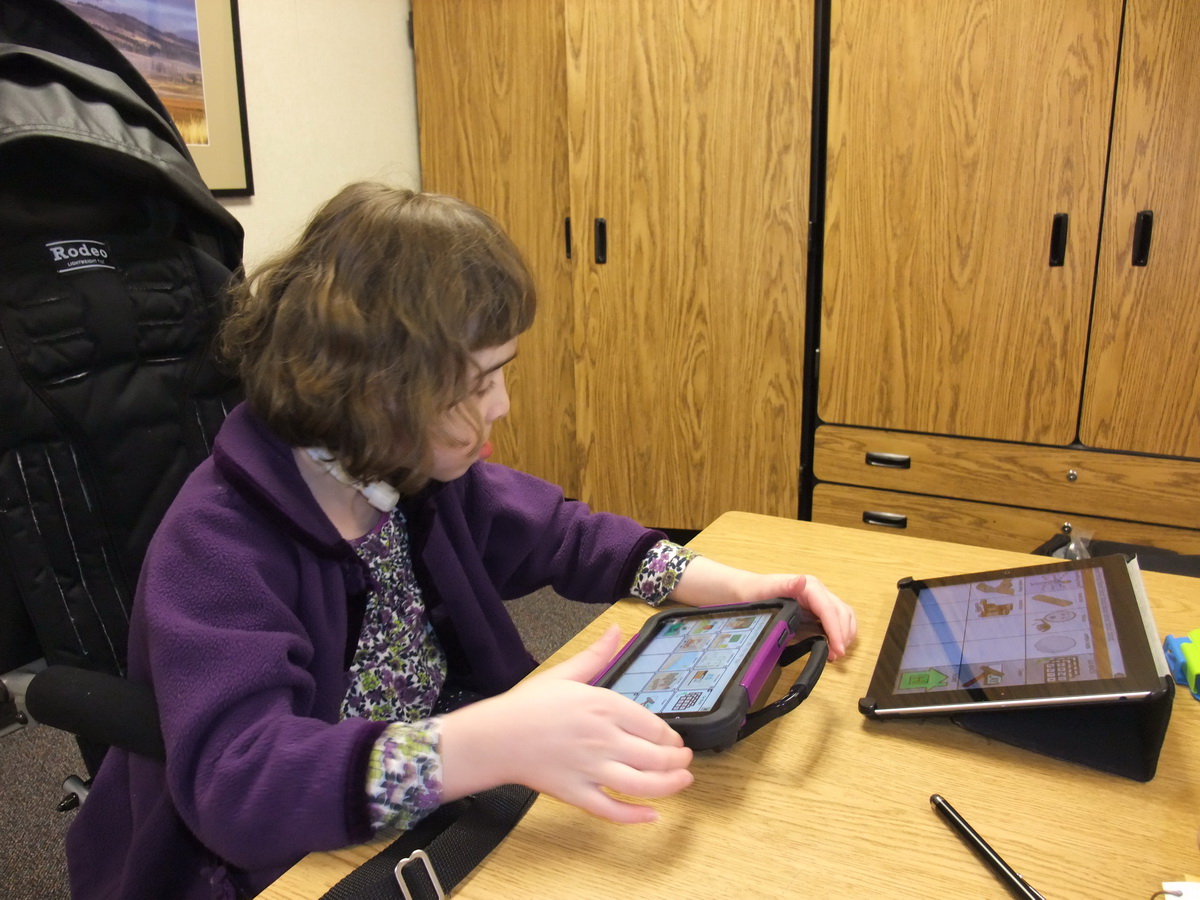
When we moved into the Lake Washington school district we lost the Vantage and it was agreed that we would try an IPad with communication software on it, provided by the school. It requires a lighter touch and different skills we wanted to see how she would do. After "playing" with it for nearly 6 months she has progressed a lot. She can even swipe to scroll through pages. She manages to change the wallpaper, move icons around the desktop and even get onto YouTube (scary!).
It's amazing to look back. There was actually a day when part of my "therapy homework" was to working on teaching her to point and it was really slow progress. It was too hard for her to keep her arm steady, she couldn't keep the other fingers out of the way and it was hard for her to guide her hand to the precise location.
Last year I started the process to get a re-evaluation. This too requires a referral in the system, copies of her IEP and speech evaluations, signed forms, completion of a lengthy questionnaire etc. I'd heard about a new communication device that would be coming out at the end of the year called the Nova 7. My fingers were crossed that this was the "one" and it was. Things I like about it: better pronunciation of basic words, handle and neck strap for portability, a sturdy stand(IPad doesn't have this), a built in amplifier for use in loud rooms, touch screen technology(with Gorilla glass for durability), a rubberized case in case she drops it, a child's voice(nice to have for a child so Ainsley doesn't sound like an adult with a British and Bostonian accent who doesn't know English very well), software to allow programming on the PC (instead of just the device), and continuity of use (the Nova 7 can use the same screen layout as her current AAC).
Paperwork was submitted this week and we are waiting for funding authorization to come through. Here are some pictures and video of her with the new device. We're also waiting on a referral for a speech therapist to work on vocalizing. I haven't given up on that yet.
A close up.
You can see she loved it. It comes with a stylus too, a nice feature until you lose it.
It uses the Android platform. Here it is next to the IPad so you can compare size. I asked her and she said she likes the Nova 7 better.
AFOs
I decided to get AFO's for Ainsley. She'd had a pair of soft AFO's. Not custom but the same idea. They really didn't make much difference for her and I was afraid that her ankles would become weak in the braces. She wore them at school every day until she outgrew them. We used DAFO Pollywog inserts for the past year or so. They helped keep her foot in a decent position but even after the leg plate removal more than a year ago and the progress she made initially she is no closer to standing or walking. The way I see it, it's worth trying them. Though it was a very traumatizing (it shouldn't be but it was). She started to get upset when he wet the plaster and then became really upset when he went to cut them off. Here's the process for those who would like to see:
1. Take off shoes and socks (Note still happy.)
2. Add stocking and making marks with Sharpie for ankle bones. Note tube inserted into stocking.
3. Pick out brace material. Fun. Ainsley chose butterflies.
4. Wrap legs with plaster coated gauze.
5. Add water and make gooey plaster. Things start to go bad.
6. Put foot into ideal position and hold until firm.
7. Cut cast off. Tube protects skin from being cut.
8. The orthotist inspects the cast
9. Ainsley signs "all done". Sadly we were not done and when he started the wrap a second time she lost it and then when he had to re-do it she came unhinged.
10. After a week or so the braces arrive and are fitted to the patient. She remembered him and started to cry again even though we explained there would be no casting, though it wasn't quite as bad as the casting day.
Here she is at home wearing them. Luckily I had some hand-me-down Keen's that worked. Then we worked up to wearing them an hour at a time. She wears them to school but signs "off" the second she gets home. Her pleading little face is hard to resist. They make it hard for her to get up and down from crawling and her gait is a little odd still. I hope it gets better. We need more time before I commit to an opinion.
Walking/Walker
Check out this video of Ainsley cruising (with support) the biggest obstacle for her is standing balance. In February we met the new orthopedic doctor for routine follow-up. Ainsley's x-rays look good and although she will still need an x-ray every 6 months, it is unlikely that any further surgery will be needed. Her hips have pretty good coverage over the femur and the donor bone appears absorbed. The legs look good where the plates were removed. The reason she isn't walking isn't really her hips, but having hip dysplasia really didn't help any. Plus she's spent so much of her life unable to move. Now days she's been rockin' the hammock and it is helping her a lot. She can now get in by herself sometimes. It's been really fun for her and that is good because it motivates her to be in a semi-standing position and her legs are now quite strong. She also uses a walker at school every day and weather permitting, in our driveway. She does some walking in the house every day, holding our hands. It's on Steve's to-do list to remove her arm troughs and add the hand grips to her walker. I'm going to make bumpers for it so we don't have to worry about the walls and furniture. Stay tuned for pictures. I doubt she'll use it much on her own (likely she'll prefer to crawl) but at least we can use it for PT during the rainy season.
Climbing
Ainsley has gotten pretty good at climbing. At the doctor recently she climbed in and out of the wheelchair completely by herself. She can also get in and out of a chair at the dining table. And on and off a bed or couch. It's great to see her be able to be a bit more independent.
Kisses
Oh my gosh is she going through a phase. I like to give my kids lots of hugs and kisses and she's learned that I like kisses (there was a time when she couldn't do it so we made a big deal when she did) so lately she uses kisses to try to get what she wants. She comes over to the computer and kisses me over and over asks, with sign language, for a DVD. It works. And now she's kissing me all the time and you can even hear her kiss. That's good for her lips. I hate that I have to think that way but after years of working with Ainsley just to try to make an "O" sound I'm rather desperate for some progress. I want her to at least learn to say a verbal yes and no. One day I'll be sorry when she learns the word no, but I know that. For now we're using a combination of things. Vocalization, sign language, body language word approximations, and the IPad. Here is an example of how she communicates with her AAC device.
Cincinnati
I've been planning on taking Ainsley to Cincinnati to get a second opinion in the Spring after cold and flu season. They have a top rated airway team and some advanced testing. The fact is Dr. Cotton probably sees more complex pediatric airways than anyone else in the world. Our surgeon has been on the fence about a cricoid split since Ainsley was a baby. We've been encouraged to wait and see if growth helps her, and every year we're asked to wait longer. I've suspected all along that she'd end up needing an airway surgery. But if Dr. Cotton tells us he isn't confident that surgery would help then we can lay it to rest. We hope Ainsley won't need the trach for the rest of her life but if she does so be it. If he thinks surgery is a good idea then we'd probably be hoping to get it scheduled over the summer.
We got a date today and we will be there from 5/21-23. I am hoping to meet up with some of the moms from my pediatric trach group while we are there. My sister Sheryl has agreed to come with me. Hooray!
Eyes
As you probably remember, I was very disappointed with the result of Ainsley's eyelid surgery in December 2010. I had hoped that the appearance of her eyes at birth could be restored to her. The surgeon did what he felt had to be done. I won't go into it in detail again, the whole thing is rather complex. But before Ainsley's second cranio-facial surgery when she was 9 months old her eyes were far more open and straight. In fact they didn't close at night and we had to put ointment in them to keep them from drying out. Now we have the reverse problem, they are too closed.
I have struggled to understand what went wrong, and the doctors weren't sure. But after giving it countless hours of thought I think it comes down to that her eyelid function was poor at birth but the excess bone from the sagittal craniosynostosis helped lift the lid and so her eyes appeared much more normal. When the bone was removed/reshaped it created droopiness.
We've been considering a frontalis sling operation since she was a baby. She needed to be 4-5 years old and now she is. We also needed her lids to be in their final position. Both the brow implants and the tarsal switch surgery each elevated her lids a few mm's. The brow implants also give the occuloplastic surgeon a solid surface to work with because the bone was thin.
What they do is attach some material (could be synthetic or tendon from her leg) to the muscle in the lid and the forehead muscle. It helps elevate the lid(s) and compensates for the abnormal muscle tissue (which combined with the cranio-facial surgery is the reason Ainsley's lids are so droopy. The surgeon will have to be careful not to lift them too high or she might not be able to close them. Luckily this is a surgery that can be undone or adjusted if needed.
We've recently thought perhaps we should go back to the surgeon who did the tarsal switch because he's been "in there" before and knows her anatomy. Plus we would like him to open up the left eye by a mm in the corner. Also he does cosmetic work so he will have a slightly different approach than the other occuloplastic surgeon who deals more with kids who have complex vision issues. We will at least meet with him and see. Our appointment is 4/3. Our goal would be to have the surgery some time this summer.
I know that her eyes will never be the same but I do hope this helps for so many reasons. I miss being able to see in her eyes like here. My friend Christy said to me that that alone is enough of a reason to do the surgery. I'd like to think she is right. For those who don't remember here is what they looked like before. This was her normal eye position but she could use her forehead muscle (the way the sling will work) to lift them fully open which she did a lot of the day (before the surgery). They are so dark and beautiful. I can't explain how hard it is to feel you can't see into your childs' eyes.
Physical Therapy
I also asked the craniofacial Ped for a referral for physical therapy. I would like to work with someone who can teach Ainsley how to fall. I think that if she wasn't afraid to fall she would take more risks to try standing which really is a precursor to walking. Nearly every day I stand her up and hold her gently at the hips and try to see if she can stay in position if I let go. She only needs the tiniest bit of a touch. I remember her physical therapist, Gay, doing that with her when she was 2. She was able to do the same thing then. I don't know what it's going to take for her to learn to balance on her feet. Ainsley receives PT through the school but it's just not enough.
We've had great success with the hammock. Ainsley hangs in it for hours every day and that is great for leg strengthening because she is somewhat standing in it, (with the support of the hammock under her arms). She also loves to sit in it and swing. That is great for the vestibular system (helps with balance). I've got the supplies to make a bouncer which I hope will get her in a better more upright standing position.
******
So we're gearing up big time. Hopefully there will be good news to share in some of these areas in 2012. Thanks for reading.
Ainsley is now nineteen years old! She is one of a kind and has navigated this world in her own special way. She's been through more than most people ever will in their entire life but that doesn't get her down. If she likes you she just might flash you a smile that will melt your heart.
I am Ainsley's mom and the author of this blog. I am also mom to Ainsley's big sister Evie and brother Adrian. Normal life seemed busy and challenging enough before Ainsley came around in 2006. Managing the care of a medically complex special needs child is something I never imaged yet together as a family somehow we do and life is good.
Ainsley's blog was created in March 2008 in preparation for a medical trip to Cincinnati, OH. At that time it was a great way to help friends and families stay up to date on happenings. In addition it has served as a sort of diary of our experiences. There are many times that I refer back to it for information or dates of a surgery or procedure, and am reminded of forgotten details about something that happened. I've posted less in recent years and wish I had posts for some important experiences.
Over the years I've had parents contact me to say that the blog has been helpful to them in one way or another and that meant a lot to me. Like me, many parents of medically complex kids are looking for information on how best to help their child, especially in the early years. Sharing our stories helps. Although blogs are less popular these days I still find it useful. If you still enjoy blog posts I'd love it if you'd leave a comment and let me know.